

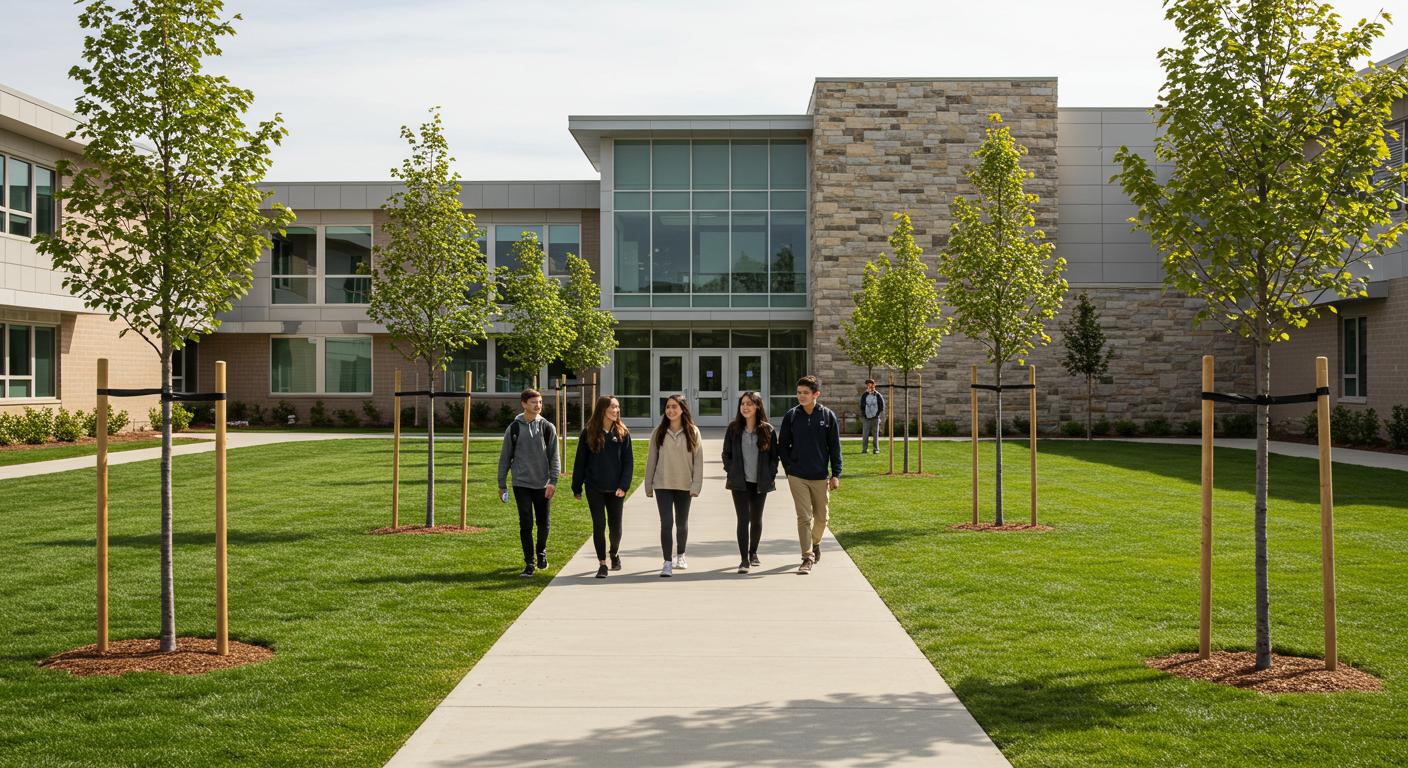
Most private schools invest heavily in their facilities without thinking deliberately about how those facilities function as a marketing tool. The campus a school occupies, how it looks, how it feels to walk through, and how it is presented to prospective families, communicates something about the school before anyone says a single word. Schools that understand this tend to use their physical environment strategically. Those that do not often miss one of the most persuasive enrollment tools they already have.
The First Impression Happens Before the Tour Begins
A prospective family's assessment of a school begins the moment they turn into the driveway. The condition of the grounds, the clarity of the signage, the ease of finding parking, and the welcome they receive at the entrance all form an impression that colors everything that follows. A campus that feels well cared for signals that the institution takes pride in its environment, and families transfer that perception onto the quality of the education being offered inside.
This does not mean a school needs a new building or an expensive renovation to make a strong first impression. It means paying attention to the details that communicate investment and intentionality. A clean, clearly marked entrance, well-maintained landscaping, and a reception area that feels welcoming rather than institutional can do more for a prospective family's confidence than a state-of-the-art science lab hidden behind a confusing set of corridors.
Signage and wayfinding are worth specific attention. Prospective families visiting for the first time should be able to navigate the campus without feeling lost or anxious. Confusion in the parking lot or at the main entrance creates a low-level stress that persists into the tour itself and subtly undermines the family's overall experience of the visit.
How Physical Spaces Communicate Values
Every space on a school campus tells a story about what the institution prioritizes. Classroom arrangements, hallway displays, common areas, and outdoor spaces all carry meaning that families read, often without consciously registering that they are doing so.
Classrooms that display student work communicate that student output is valued and celebrated. Hallways that feel like curated galleries rather than blank corridors give families a sense of what students are creating and thinking about every day. Spaces that are clearly used for collaboration, discussion, and hands-on work communicate a different pedagogical philosophy than rows of desks facing a whiteboard. These signals matter to families who are trying to understand what daily life at the school really looks like.
Outdoor spaces deserve the same attention as indoor ones. Athletic facilities, courtyards, gardens, and gathering areas all contribute to the sense of what student life feels like. A school with beautiful outdoor spaces that are clearly used and loved by students communicates something meaningful about the relationship between the institution and its community. Spaces that feel neglected or inaccessible undermine that message regardless of what the admissions brochure says about outdoor learning or student wellness.
The library, makerspace, arts facilities, and any specialty program spaces are particularly influential during tours because they represent the distinctive offerings that families are often specifically seeking. These spaces should be presented at their most active and alive whenever possible, with student work visible, materials accessible, and evidence of real use rather than careful staging for visits.
Opening the Campus to the Community
A campus that only prospective families encounter during formal admissions events misses a significant opportunity. Schools that open their facilities to the broader community create organic familiarity with their environment that pays enrollment dividends over time.
Hosting community events on campus serves multiple purposes at once. It generates goodwill, it creates reasons for non-families to experience the school's physical environment directly, and it positions the school as a contributor to the broader community rather than a self-contained institution. A family that has attended a community lecture, a youth program, or a public performance on a school's campus arrives at an open house with a baseline of familiarity that changes the nature of the visit entirely.
Sports and arts events that invite community members onto campus are particularly effective because they tend to draw the specific demographic of families with school-age children. A youth sports tournament, a community theater partnership, or a public student exhibition all bring the right audience into direct contact with the campus at a moment when they are in a receptive frame of mind.
Summer programs, enrichment camps, and after-school programs that are open to non-enrolled students serve a similar function. Families whose children participate in a school's summer camp experience the campus and its culture from the inside before they ever consider formal enrollment. The transition from camp participant to enrolled student is considerably shorter than the transition from a stranger to an enrolled student.
Maintaining the Campus as a Year-Round Priority
The campus that prospective families see during a fall open house should look as good as the campus that current families experience every day in February. Schools that treat campus maintenance and presentation as a seasonal priority tied to the admissions calendar are doing themselves a disservice.
Current families are the school's most important marketing asset, and the physical environment they experience daily shapes how they talk about the school to others. A campus that feels neglected or poorly maintained communicates a lack of investment that current families notice and that influences how they represent the school in the conversations that drive word of mouth. Maintaining the campus as a year-round priority is not just about impressing prospective families. It is about reinforcing the confidence of the families already enrolled.
Photographs and video content of the campus should be updated regularly and should reflect the campus across different seasons, times of day, and types of activity. Marketing materials that feature outdated images of spaces that no longer look the same create a disconnect between expectation and reality that prospective families notice during visits. Fresh, accurate visual content reinforces the school's credibility rather than inadvertently undermining it.
Small investments in the physical environment often produce disproportionate marketing returns. Refreshing the entrance area, adding student artwork to public-facing spaces, improving outdoor seating in gathering areas, or simply ensuring that the most-visited spaces are consistently clean and well-presented costs considerably less than a paid advertising campaign and influences prospective families in ways that advertising cannot replicate.
Photography and Video as Extensions of the Physical Campus
For the majority of families who encounter a school online before they ever visit in person, photography and video are the first version of the campus they experience. The quality, accuracy, and emotional tone of that visual content shapes the expectation they bring to an eventual visit.
Professional photography of campus spaces, taken at times when students are naturally present and active, produces content that communicates the school's environment with genuine warmth and credibility. Wide-angle shots of empty hallways tell a prospective family almost nothing. Images of students engaged in real activities in real spaces tell them a great deal. The goal of campus photography is to give families a sense of what it feels like to be in that environment, not simply to document that the building exists.
Video content amplifies this effect considerably. A short video that walks through the campus during a typical school day, capturing authentic moments rather than staged ones, communicates more about the school's culture and physical environment than any written description can. Schools that invest in quality visual content of their campus are extending the reach of their physical asset into every digital channel where prospective families encounter the school before a visit occurs.
A marketing partner with experience in school photography and video production can help schools develop a visual library of campus content that serves admissions materials, the website, social media, and event presentations simultaneously. The physical campus is one of a private school's most significant assets. Making sure it is represented as compellingly online as it is in person closes one of the most common gaps in private school marketing and gives prospective families a consistent and accurate picture of what they will find when they arrive.